Ben Nichols Game/Level Designer
Operation Phoenix
Goal:
To create a immersive 3 part story that uses environmental story telling to guide the player through the world.
Project Breakdown
-
2 Months
-
Unreal Engine 5
-
Blockout
-
Marketplace Assets used
-
FPS Game Starter Kit
-
AI behavior toolkit
-
Medieval Castle Modular Vol 1
-
Old Mine Tunnel and Caves
-
Level Focuses

Level 1 - House
Gameplay Beats:
- Intro to story
- Exploring house
- Find underground cave entrance
Level pillars:
- Environmental story telling to invest player into story
- Scripted events to guide player through level
Level 2 - Mines
Gameplay Beats:
- Fight your way through mine
- Enter dialogue with antagonist
- Make important decision (determines ending)
Level Pillars:
- Use of lighting to guide players e.g. flashlights, lights of mine carts etc.
- Using level layout to slow gameplay down for interaction with antagonist.
Level 3 - Castle
Gameplay Beats:
- Fight way to inner keep
- Explore keep
- Kill antagonist and defuse bomb
Level pillars:
- Using AI and the flow of combat to direct player to their objective
- Building tension in the level with a count down timer, intense combat and fast pace action and music
Level Development
Environmental Story telling
Throughout the levels I aimed tell a strong story through the environment.
Story telling elements:
- Scale of weaponry smuggling operations
- Evidence of what's really going on dotted around
- Giving levels life e.g. living quarter etc.
Feel
Tension:
- Building up the number of AI throughout he levels climaxing in a massive battle in Level 3
Flow:
- There's a refreshing feel to each level, with each level building on the story of the game and adding layers to the games intensity.
References
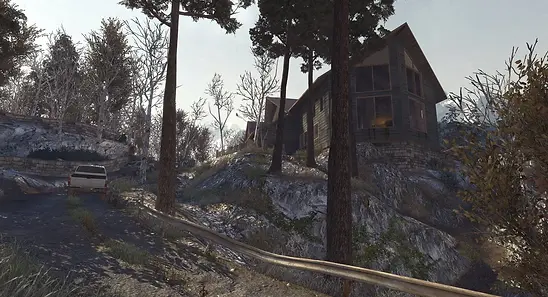
This game was heavily inspired by Modern Warfare 2 with the combat style and gameplay mechanics.
I specifically was inspired by the MW2 level 'Loose Ends' which has the player battle to the main antagonists house. Which inspired Level 1 of my game.
Thoughts:
Really happy with how these levels turned out, think there is a clear sense of progression through all 3 levels and the tension builds up nicely.
Improvements:
-
Minor tweaks to numbers of AI in each section.
-
Add more scripted events
Deeper Breakdown
Development timeline


I planned my work in weekly sprints with a timeline similar to the one above. I structure out what I wanted to achieve each week then breaking down tasks for each week. This technique allowed me to constantly review the progress I was making each week and highlight any issues that were occurring.
Development of the levels
Level 1:

House 1
House 2
House 1

House 2


Player path:
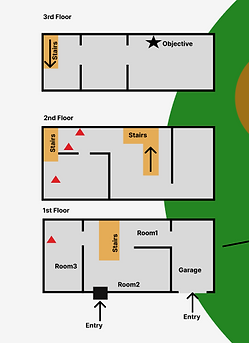
The player path for the first level was to have them run into the first house collect data and then progress onto the second house where the transition to level 2 is.
Player Perception:
I used AI and the perspective of the player to drive them through the first level.


Player Perception of space:
One of the concepts I love in games is a map that manipulates the players perception of a space. E.g. Going from a really small space into a huge space.
I referenced El Chapo's underground smuggling tunnels, where tunnel entrances would be hidden under bath tubs or fake stairs etc. This shock value is what I was aiming for when the player discovers the entrance to the underground tunnel network, which acts as a transition into the second level.

Level 2:


Indicating:
Using lights, AI and mine tracks to indicate to the player the direction they need to go.

Pushing Narrative
The focus of the 2nd level was to push the narrative of the game and change the perception of the story as the player traverses the level.
Short overview of story:
You're tasked with hunting terrorists that smuggles arms and people. In this level you'll find evidence that shows that the terrorists are actually helping people. If you choose to believe that the terrorists are right the game will end in this level, otherwise you can kill the antagonist/mini boss and continue onto the third and final level of the game.

Introducing conversation:
Step 1: Slow down gameplay:
Making the player jump over the box forces the player to slow down.
Step 2: Getting players attention to dialogue:
By having large bold white text that grabs the players attention.
Environmental story telling to drive narrative:
Notes were used in the level to progress the narrative. Notes would showcase thank you letters from the people that had been smuggled, indicating that in this scenario the terrorists were telling the truth


Level 3:

AI


Combat flow
-
Direction: Using AI and the flow of combat to direct players to the final objective.
Tension:
One of the goals with the story being across three levels was to build the tension of the game up as the game progressed. This can be seen in the final level where the game reaches it's climax, with the player being placed in the centre of a full scale battle for which they now have to fight their way through.
Testing Tension & Atmosphere:
I created a chart that showcased the level of intensity I wanted to the players to feel throughout the game. I then got testers to play the game and mark where they felt the levels of intensity were in the game. By doing this I was able to see if the players were experiencing the levels of intensity that I had planned in the game.

Orange: Testers results
Blue: Predicted results
What results indicate:
- This was a great way to test the feel of my game and showcased to me that players felt that the level of intensity increased as the game progressed, showing that game was flowing as expected.

Creating tension:
-
Positioning AI to build up tension in the level i.e. at the start of the level (image to left) player will be surrounded by enemies.
Sustaining tension:
-
As the player progresses through this level they will be surrounded by combat, this was designed to sustain the tension and the action packed feeling that the game has been building during the previous levels and make it reach it's climax in this scene (creates the feeling of pure chaos).


Affordance
Affordance: Telling the player what they can afford to do
Using affordance:
(Below is referencing the video on the right)
- Text: Using the text 'You'll never get in here' tells the player they can 100% can get in there.
- Large cracks in door: Popularly used in games to showcase that an item is fragile.
- Conveniently placed RPG: RGP is placed directly in front of the door and glows and when approaching it.
All these elements combined tell the player what to do without telling the player what to do.

Mechanics
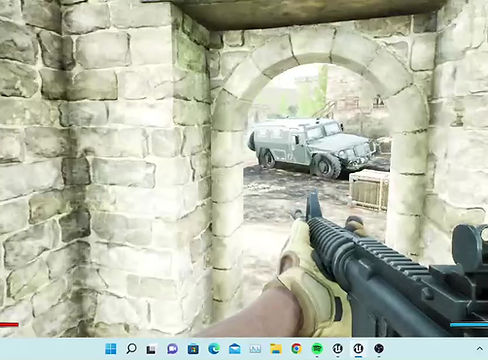
To help build the tension and keep the flow/pacing of the game I introduced a bomb/defusal mechanic into Level 3.
This mechanic is design to add to the chaotic nature of the final level, making the player feel like they need to get across the map as fast as they can.
The mechanic also helps to keep the story/narrative at the forefront of the game and even though there is chaos all around the player it helps keep them focussed on the main objective. (Gives the impression that they don't have time to sit back and take out every enemy minion.)
Once the defusal is complete, the player will have finished the game with the 3 ending (see below).

Narrative
Mission briefing:
Your goal is to bring down the terrorist organisation ‘The Phoenix group’ notoriously known for smuggling both weapons and more importantly people across the world. A poster child for this is Jasmine Course a Egyptian politician who has recently been taken captive by the group.
In this game you’ll be missioned with finding the infamous smuggler ‘Zane Maralis ’ who has ordered a drone strike on a innocent facility in Egypt. You goal is to find the control console, stop the drones last orders and hopefully find out the where-abouts of Jasmines location.
Endings
In the caves in the 2nd level the player will be confronted by Max Maralis (Zane's daughter) and given the option to believe the terrorists innocence in this scenerio or not.
Ending 1#:
- Choose to believe Max and get the first ending

If you don't believe the terrorists you'll continue fighting until the end of level three where if players are observant they can find in the final room of the level a note from Jasmine proving the terrorists innocence.
Ending 2#:
- Player looks at note and calls off the assault

Ending 3#:
- Player continues the mission, disabling the last drone orders.

Narrative Gameplay Beats

Narrative Usability Testing
I used Narrative Userability Testing in my project to test my narrative before committing to the story. For this I wrote up my narrative along with gameplay beats leading up to decisions and asked testers to comment on this story.

This was really helpful in directing my narrative and to build a strong foundation for my story, along with getting a better understanding of what players wanted when in came to the story telling in the game.
World Building and Environmental Storytelling

This projected revolved around the idea of a telling a story via the environment and using the level not only to direct the player through the levels but to tell them a story and build up the world they're in while doing so.
What was I trying to tell the player:
The story in this game is telling the player that in real life there is no such thing as black and white/ good guys and bad guys (Everyone's got agendas and conflicting opinions). The narrative in the game tells the player that the terrorists are the good guys (in this instance) but I wanted to showcase via the environment that these people were still smugglers/terrorists and that they weren't good by any means.
How do I showcase this:
One of the ways I did this was to highlight what the job of these terrorists/smugglers was. I did this by showcasing to the player the sheer scale of weapons that the group is smuggling. And as the player progresses through the levels the scale just gets bigger with the final level showcasing hundreds of creates and barrels of weaponry and the vast amount of trucks shipping said cargo.


World building:
I wanted to create a real world, a world that felt lived in. I did this by humanizing the environments including things such as spilt drinks and living quarters for the enemies into the levels to make the world feel lived in and natural.

With the right balance of level design, environmental story telling and world building I was able to create a natural feeling world that told a story and took charge of the narrative whilst making the world feel believable and natural.